Contested Landscapes
At the end of October, I’m co-curating an exhibition in Guernsey based around the theme “Contested Landscapes.” Comprised of work by painters, artists, photographers and makers, it is an opportunity to explore art practice in relation to notions of landscape and our local environment and terrain. Those submitting work are either based in Guernsey, from the island, or have a connection to it.
Landscape painting and land art has fascinated me from an early age. As a child I remember seeing the watercolours of William Caparne (1855-1940) depicting the burning of furze on the cliffs above the bay where I lived. Other memorable local works included the square slightly surreal Guernsey cattle painted by Denys Corbet (1826 –1909). I imagined inhabiting these places at the time they were created, as if landscape painting provided the onlooker with the superpower of time travel.
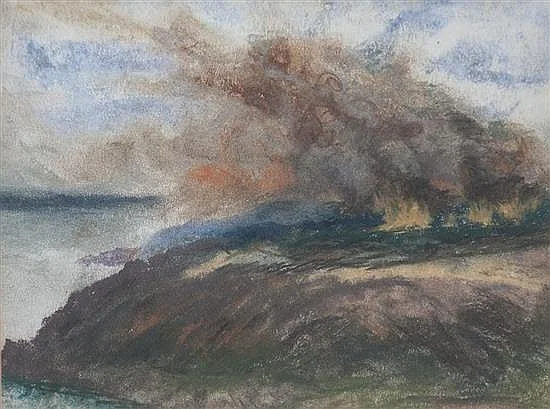
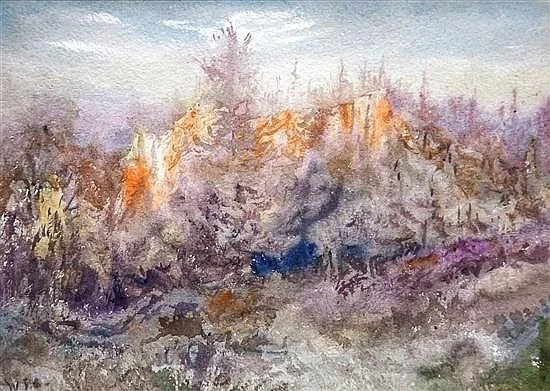
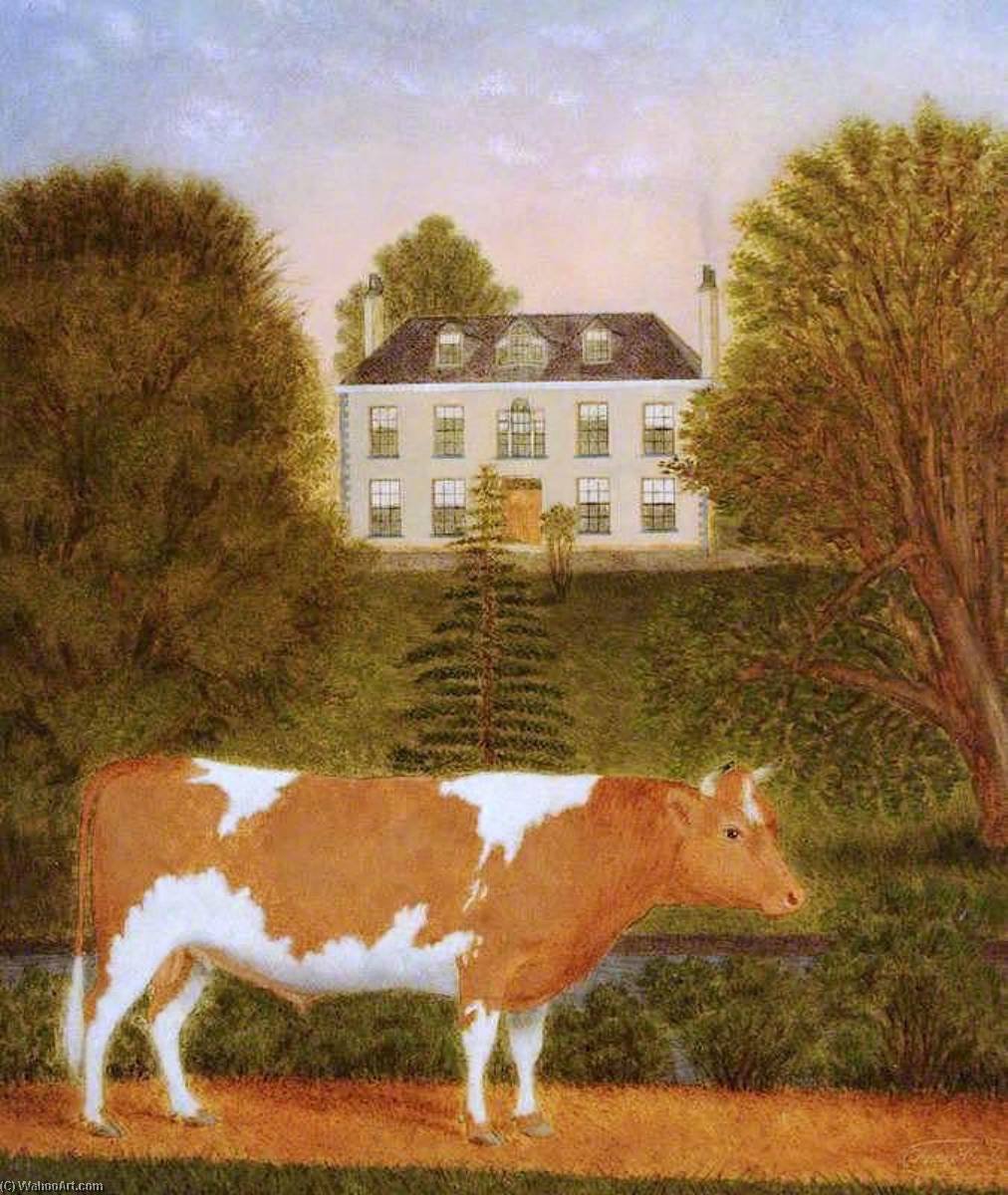
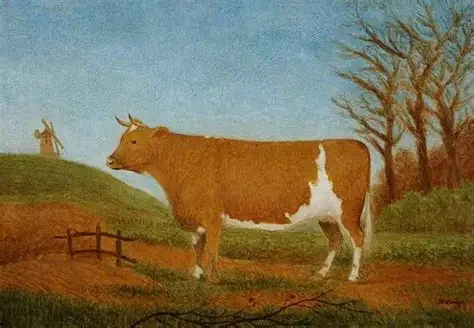
Stuffy art history lessons at secondary school were less captivating with landed gentry and hunting parties by George Stubbs, Thomas Gainsborough or John Wootton inhabiting the bucolic arcadian woodlands of the 17th and 18th centuries. About the only thing that I remember from those classes was that Thomas Gainsborough constructed miniature landscapes in his studio using sand and clay for earth, broccoli for distant trees, and lumps of coal for rocks and then worked from them, rather than treating landscape painting simply as direct transcription from nature.
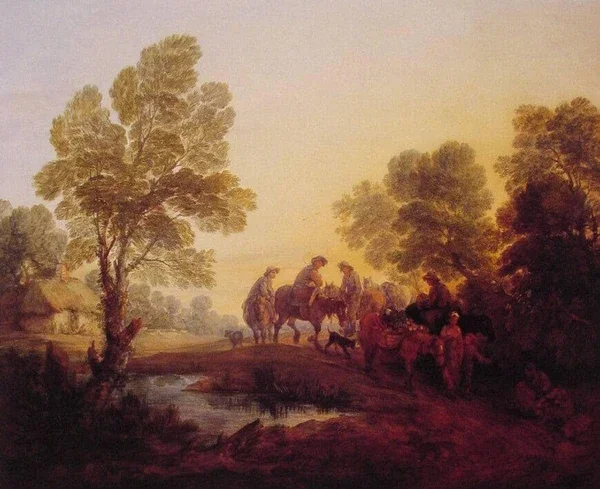
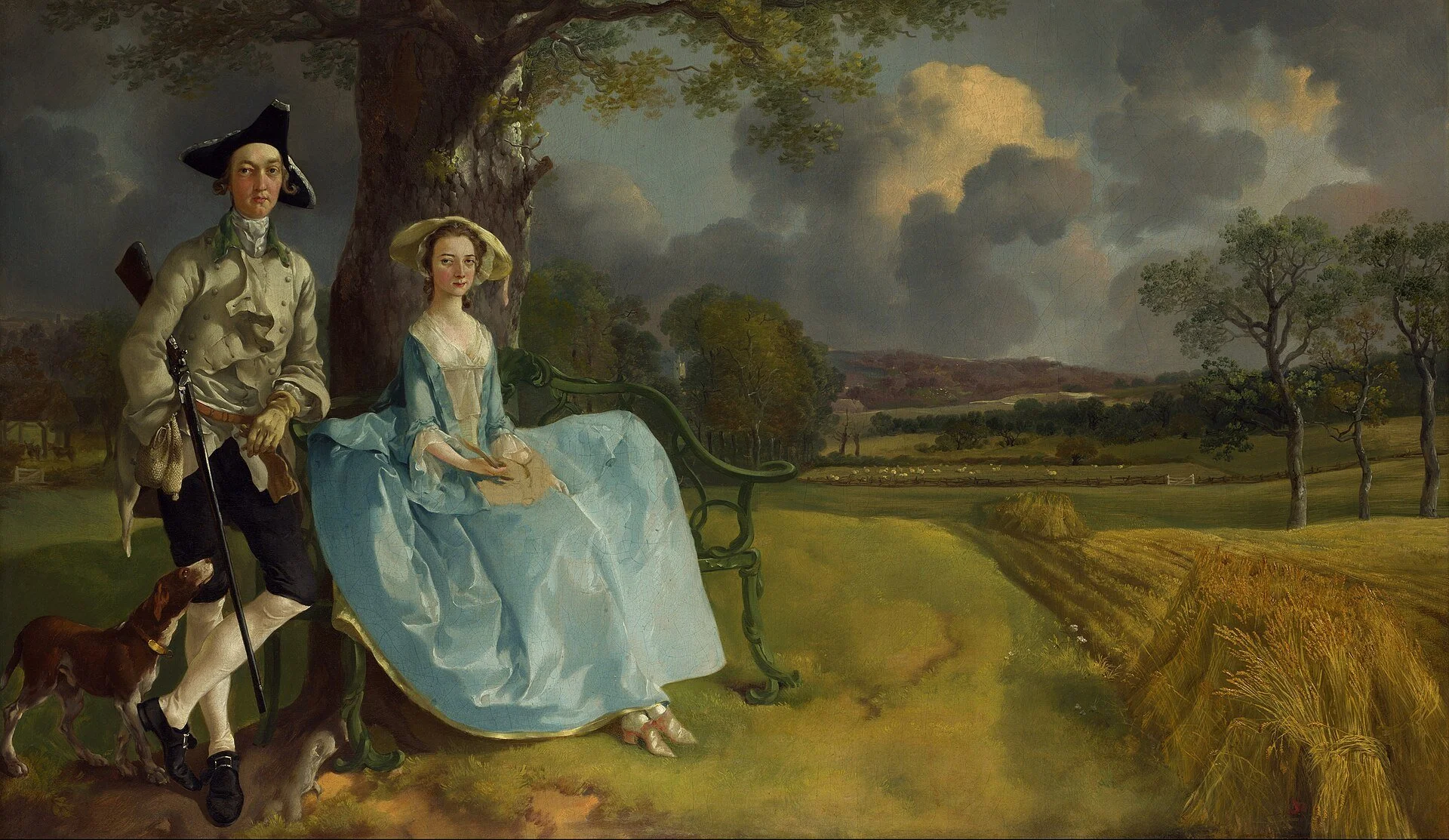
It was only much later that I realised with great joy that the smug looking Mr & Mrs Andrews surveilling their acres that my snobbish art teacher so admired, were part of Gainsborough’s disguised social commentary. The couple were subtly depicted as dominating their world compared to his earlier work where the poor were portrayed at ease in the land, carrying out work that they had the right to do under ‘customs in common’ that were being eroded by enclosures and capitalist farming. Nature is depicted as abundant but stylised – a depository for all the desires and fears that humanity experiences.
My own work has always been concerned with a sense of place; belonging and otherness; nature/culture and the human condition and how we are part of a much larger mysterious ecosystem. Returning to painting in 2020 after a long break, my starting point naturally seemed to be landscape. It was both a means of being outside during the Covid lockdown and the place where I had left my art practice in 1998.
When I put forward the idea of a landscape exhibition to the director of the Gate House Gallery, I wanted local painters, artists and makers to consider why the construct of ‘landscape’ was still relevant today.
Landscape painting as a genre may often come across as cosy and unthreatening, being the lifeblood of the art establishment. Celebrating beauty and the natural world is wonderful, but landscape also has the power to act as a contested space that challenges mainstream beliefs allowing the viewer to see the world around them with fresh eyes. It is sometimes able to make the invisible visible.
Landscape painting, land art and other forms of art practice that consider the land are shaped through both the discourse of art and and historical and socio-political context. It may consider themes such as borders, belonging and migration; colonialism, land ownership and power structures; or the consideration of environmental issues, climate change, the extraction of precious minerals or building materials. In terms of the environmental, it can be a means of documenting the loss of biodiversity as tracts of land are swallowed up by the transformational excesses of property development.
Contested landscape as a subject might also be seen as a means of considering competing and potentially irreconcilable visions of the future. On a small island, landscape is never simply scenery. It is boundary, commodity, inheritance, defence and occupation: a place where geological time, human histories and non-human processes converge.
The word landscape suggests the bucolic picturesque: cliffs, fields, granite, sea. Islands are particularly susceptible to this aestheticisation. They are readily imagined as places apart—self-contained, beautiful, reassuringly bounded and segregated from ‘the other’. Art itself has historically participated in this process, turning land into something viewed rather than something lived in.
Once shaped by boat building, fishing and farming, horticulture and small farm holds, today our island is enmeshed with the offshore finance world. The island’s property market is on par with London and the stockbroker belt in terms of property prices. Prices, scarcity of empty land and the pervasive logic of neoliberalism mean that large mansions are being thrown up at a rapid pace, while key workers – teachers, social workers and nurses cannot be recruited due to the cost of living in the Island, and the working poor cannot always afford to remain here.
To consider landscape as contested is to puncture that idyll. It asks us to consider not simply what a place looks like, but who owns it, who can afford to remain there, who decides what it is for, and whose presence is considered valuable. These questions acquire particular resonance when the island is an offshore financial centre. Finance has an oddly abstract relationship with geography. Capital is mobile; wealth crosses jurisdictions electronically; companies, trusts and assets can be organised across borders with frictionless ease.
The island, meanwhile, remains stubbornly material. Its coastline cannot expand (or at least not without vast expense and loss of important marine ecology). Homes are in short supply, schools, fields, offices and homes compete for finite space. A contested landscape is therefore also a contested social settlement. Housing raises questions about who belongs. Development pits private return against collective need. Tourism transforms the lived environment into an image for external consumption. Agriculture, biodiversity, heritage and infrastructure make competing claims upon the same few square miles. Even a derelict greenhouse or brownfield site is not empty: it contains collective memory, ecological value, family history, speculative possibility and competing visions of the island’s future.
Art matters here because it can shake these tensions to the surface without pretending to resolve them. At its most politically alert, landscape painting and art practice refuses the comfortable position of the spectator standing outside the scene. It reminds us that there is no neutral viewpoint. Where we stand, and whether we are permitted to stand there at all, is already political.
On a small island, this becomes uncommonly literal. Borders are visible. Limits are encountered daily. There is no imaginary hinterland into which an inconvenient problem can indefinitely be displaced. Waste goes somewhere. Workers must live somewhere. Buildings take the place of something else. Economic decisions eventually materialise as physical ones.
Perhaps, then, the most productive meaning of Contested Landscapes lies in shifting our attention from landscape as noun to landscape as process and transformation. Places are continually being produced through decisions about ownership, labour, planning, conservation, access and memory. The exhibition’s title consequently poses quietly radical questions. Not whose island is this? or what landscape art is currently fashionable? - with all the exclusion that such questions can imply. Instead it considers questions such as ‘how can landscape painting and art practice be used to explore contemporary anxieties?’ or ‘what does it mean to exist in a small piece of the world where beauty is evident, but the imperatives of private accumulation encounter the fragile claims of the commons and the ecological world?’.
I am looking forward to looking over the submissions that we receive next week. I know that they will be diverse in both medium and in what they are centred around. It will be interesting to strike up some dialogues between the work, the contributors and those viewing the exhibition.